



The Last Mile of Fund Accounting Automation. Why the Human Still Matters Most?

Updated: Sep 20
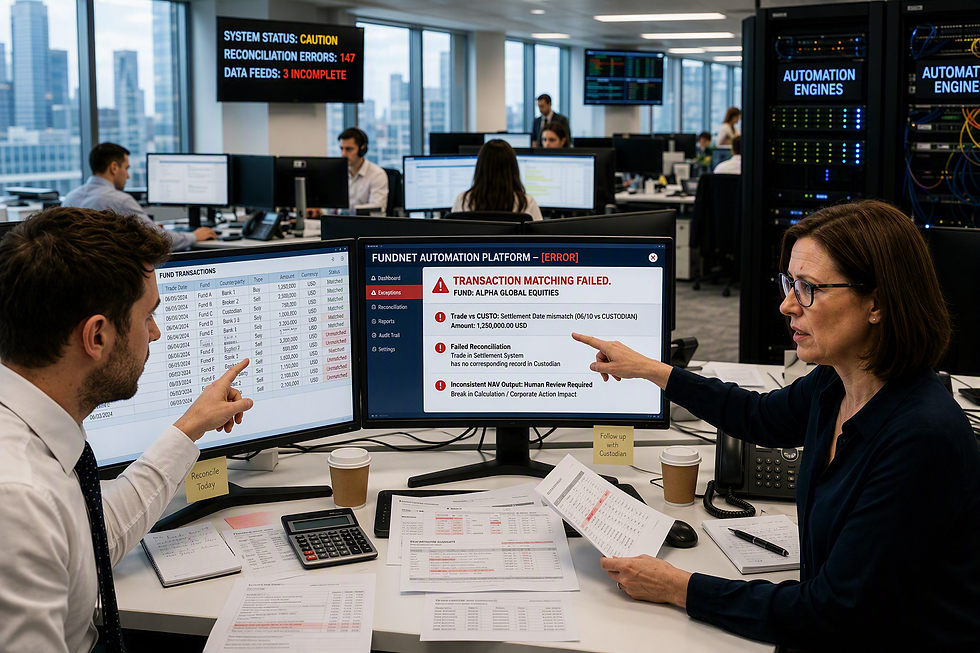
Why Fund Accounting Value Chain Still Resists Full Automation?
Financial infrastructure is undergoing one of the most profound technological transformations since the digitization of markets in the late twentieth century. Across banking, capital markets and payments, the industry is moving rapidly toward intelligent systems capable of operating with increasing levels of autonomy. Artificial intelligence is beginning to analyse risk, detect fraud, optimise portfolios and interpret complex financial data at a scale that was unimaginable only a decade ago.
Large financial institutions are investing heavily in platforms that promise greater automation across the investment servicing value chain. Technology vendors continue to introduce tools that claim to deliver straight through processing across trading, settlement, reconciliation and reporting. In parallel, enterprise software itself is evolving. For decades softwares evolved around interfaces. Humans interacted with systems through dashboards, menus, screens and workflows. The promises of enterprise systems and later SaaS were straightforward. Once a workflow was digitized, systems would execute the processes.
Fast forward to today, a new paradigm is beginning to emerge. Instead of instructing systems on how to execute each step, in the age of agentic AI, humans are now starting to define the outcome they expect, and Intelligent systems are gradually learning to determine the path required to achieve that outcome. The transition from interface driven software to intent driven systems is beginning to reshape many industries.
Yet there are certain domains where this transition proves far more complex than the technological narrative suggests. Fund administration and fund accounting belong firmly in that category. Despite decades of technology investment, the aspiration of fully autonomous operations in fund accounting remains distant. This is not because the industry lacks sophisticated systems. The challenge lies deeper in the structural nature of the work itself.
Fund accounting does not simply execute workflows. It operates at the intersection of, non-standardized inbound instructions, fragmented data, complex accounting interpretation, constant reconciliations across distributed financial ecosystems, changing regulations and ever evolving asset classes.
Therefore, understanding why automation remains incomplete requires examining the structure of the fund accounting value chain itself. Let’s begin the journey 👍
The Promise and Limits of Automation
At first glance fund accounting appears to be an ideal candidate for full automation, because its core activities appear procedural and predictable:
Transactional data is ingested.
Accounting rules are applied.
Instrument Valuations are performed.
Corporate Actions are processed.
Fees are applied.
Positions and cash are reconciled.
Net Asset Value is calculated.
Investor reports are produced.
With each step appearing structured, and every step seemingly appearing programmable, over the last two decades the industry has invested heavily in platforms designed to automate these processes. Portfolio accounting systems, reconciliation engines, market data feeds, data warehouses and operational workflow tools have become standard components of the modern fund administration environment. Technology providers such as SS&C Technologies, Temenos, Simcorp, Fund Guard, NeoXam, FIS, Broadridge Financial Solutions etc have built sophisticated accounting platforms capable of handling vast genres of multi-currency transaction volumes across global markets, applying the GAAP, IFRS & IAS standards.
Yet even today fund accounting teams remain heavily dependent on human judgment. Manual adjustments continue to occur. Reconciliation investigations remain routine. Operational teams still devote significant effort to identifying and resolving exceptions. The gap between the promise of automation and operational reality reveals an important insight.
And that is - Fund Accounting is not simply a workflow automation problem. It is fundamentally a problem of data interpretation and exception management.
Let’s see how ....
The Structural Barriers to Autonomous Fund Accounting
Data Acquisition Challenge
Automation begins with reliable data. In fund accounting that requirement is rarely straightforward. The accounting process relies on information drawn from a wide ecosystem of institutions and platforms.
Custodians
Brokers and prime brokers
Market data providers
Transfer agents
Portfolio management systems
Internal trading platforms
Each of these participants produces data independently and often according to their own structures, reporting conventions and operational timelines. Trade confirmations, position statements and price feeds frequently arrive in inconsistent formats. Timing differences between systems are common. Instrument identifiers do not always align across platforms.
Before accounting calculations even begin, operational teams must first validate and normalise this incoming information.
They verify data integrity.
They correct structural inconsistencies.
They fill missing attributes.They reconcile timing differences.
In practice fund accounting often begins not with accounting logic but with data interpretation. Automation struggles in environments where inputs are inconsistent or incomplete. Autonomous systems require stable pipelines and predictable inputs whereas the financial ecosystem within which fund accounting operates remains fragmented. This fragmentation explains why large fund administrators maintain extensive data management functions that exist purely to ensure that incoming information is usable.
Complexity of Accounting Rules
Once data is gathered and validated the next step appears straightforward. Accounting rules must be applied to determine the correct financial representation of the portfolio. However in reality these rules are rarely universal. Each fund may operate under its own configuration depending on its structure, strategy and regulatory environment.
Valuation policies may differ.
Asset class treatments may vary.
Corporate action processing can follow different interpretations based on jurisdictional variances.
Fee structures are unique to each fund.
Equalization methodologies vary.
Investor share classes introduce additional layers of allocation complexity.
As a consequence, calculation of Net Asset Value, the central output of fund accounting, depends on the interaction of these rules across every position held by the fund. Not to forget that Errors in these calculations carry significant consequences. They can trigger regulatory scrutiny and may require compensation to investors who will subsequently enter and exit the funds. What complicates automation is not simply the number of rules involved but their contextual nature. Accounting rules evolve. They vary across jurisdictions. They sometimes require interpretation. Modern accounting platforms are therefore highly configurable frameworks rather than rigid processing engines.
Even the most sophisticated systems encounter situations where accounting logic collides with unusual events or unexpected market conditions. And when this occurs human accountants step in to determine the correct treatment. In other words, the system pauses not because it cannot process transactions but because the rules themselves require judgment.
Reconciliation and Exception Reality
Perhaps the most persistent challenge in fund accounting lies in reconciliation. Every operational cycle requires comparison of financial records across multiple independent systems.
Trades must be reconciled.
Securities positions must align across custodians and internal books.
Cash balances must match external statements.
Valuations must correspond with market data providers.
These comparisons are performed across institutions that maintain their own systems and reporting schedules, so that even when reconciliation tools automate the matching process discrepancies inevitably appear. These breaks can arise from timing differences between systems. They may originate from inconsistent counterparty data, delayed price updates, transaction complexity or simple posting delays.
Reconciliation technology developed by firms such as SmartStream Technologies, Duco etc can identify mismatches quickly and accurately. However detection is only the first step. Resolving a break requires investigation. It requires tracing transaction flows, understanding system behaviour and determining the correct resolution.
In short, while Automation detects the anomaly. Human judgment resolves it.
An Exception Driven Industry
These structural realities reveal something fundamental about fund accounting. It is not primarily a transaction processing industry. It is an exception management industry. The majority of transactions move through systems automatically. Modern platforms are capable of processing enormous transaction volumes with minimal intervention. Yet the operational effort of fund accounting lies in the minority of cases where systems encounter inconsistencies. These exceptions define the workload. They define operational expertise. They also explain why complete autonomy remains difficult to achieve.
As financial markets evolve the complexity of portfolios continues to increase. Funds invest in derivatives, structured instruments and private assets across global markets. Each new asset class introduces additional valuation and accounting considerations. With complexity comes more exceptions. And since automation so far has only increased efficiency but hasn’t eliminated the need of interpretation, unless technology evolves to an extent where it can fast remove the frictions and completely replicate human cognitive intelligence to do these interpretations unsupervised, attaining full automation may remain a difficult target.
But before we can even start contemplating about automating human interpretations in fund accounting let’s see what are the frictions which needs to be taken care first.
The Path Toward Intent Driven Fund Operations
The movement from interface based systems to intent driven operations still holds tremendous potential for fund administration. However achieving this transformation will require deeper changes than simple workflow automation. The following 3 shifts therefore are likely to shape the next phase of evolution.
Data Standardisation
Autonomous systems require unified and reliable data pipelines. This implies greater industry alignment around standardised reporting formats, consistent instrument definitions and harmonised data structures across counterparties. Without such standardisation intelligent systems spend more time cleaning and interpreting data than analysing it.
Rule Abstraction
Accounting logic must gradually evolve beyond rigid procedural code. Instead of encoding every scenario within predefined workflows systems must be able to interpret accounting policies as machine readable principles. This abstraction allows technology to reason about financial outcomes rather than simply execute instructions.
Exception Intelligence
The most important frontier lies in the intelligence applied to exceptions themselves. Future systems must move beyond detecting reconciliation breaks. They must be capable of identifying root causes, predicting resolution paths and suggesting corrective actions based on historical patterns. This represents a shift from transaction processing toward anomaly understanding. Artificial intelligence will likely play a significant role in this transition by augmenting investigative reasoning rather than replacing accounting expertise. Large global custodians are already exploring technology models that embed intelligence within operational platforms to assist with exception analysis.
From Processing Systems to Financial Reasoning
If these changes unfold successfully the nature of fund accounting technology will evolve. Operational systems will gradually begin to resemble financial reasoning engines rather than traditional processing platforms. Instead of navigating dashboards and workflows accountants may increasingly define outcomes. Produce the Net Asset Value. Validate the integrity of the portfolio. Confirm investor allocations. The system will orchestrate the necessary steps. It will gather data, apply accounting policies, reconcile records and resolve predictable discrepancies.
This is what intent driven financial operations may eventually look like.
A Final Reflection
At its deepest level, fund accounting performs a role that goes beyond operational processing. It acts as a layer of trust within the financial system.Investors commit capital to funds with the expectation that the value of their holdings is calculated accurately, that transactions are recorded faithfully and that the economic reality of the portfolio is represented without distortion.
The daily calculation of Net Asset Value is therefore not merely an accounting exercise. It is a mechanism through which confidence in investment vehicles is maintained. Technology can automate many aspects of this process. It can gather data faster than humans, reconcile records at enormous scale and detect inconsistencies within seconds. Yet trust in financial systems rarely rests on automation alone. It rests on the alignment between data, rules, interpretation and accountability.Fund accounting exists precisely at that intersection.
This is why the industry continues to rely on human judgment even in an era of increasingly sophisticated technology. Exceptions must still be understood. Context must still be interpreted. Responsibility must ultimately reside somewhere. The transition from interfaces to intent will undoubtedly transform financial operations in the years ahead. Intelligent systems will take on larger portions of the operational burden and the role of the human accountant will continue to evolve. But the deeper purpose of fund accounting will remain unchanged. Its role is not simply to process transactions. Its role is to ensure that the financial system continues to operate on a foundation of transparency, accuracy and trust.
Only when technology strengthens that foundation will the industry truly move from processing financial activity to executing financial intent.
In such a complex operational landscape, the arrival of agentic AI will naturally raise expectations of deeper automation. Large language models already demonstrate an ability to interpret instructions, reason across datasets and simulate aspects of human cognition that were once thought to be uniquely human. In many operational environments this may prove transformative. Yet the world of fund accounting presents a more delicate terrain. Here decisions often depend on subtle interpretation of fragmented data, contextual accounting policies and the resolution of exceptions whose meaning cannot always be inferred from patterns alone.An autonomous system may assist, suggest and accelerate investigation, but it must also navigate the well known limitations of generative models, particularly the risk of confident but incorrect conclusions that arise from hallucinations. In a domain where a single misinterpretation can distort valuations, affect a vast multitude of investor allocations or trigger regulatory consequences, the tolerance for such uncertainty is extremely low. For this reason the future of fund accounting will likely not be defined by machines replacing human judgment completely, but by intelligent systems augmenting it carefully. The challenge will not simply be building systems that can act autonomously, but designing systems that know when autonomy must yield to human understanding.


Excellent Prasoon.